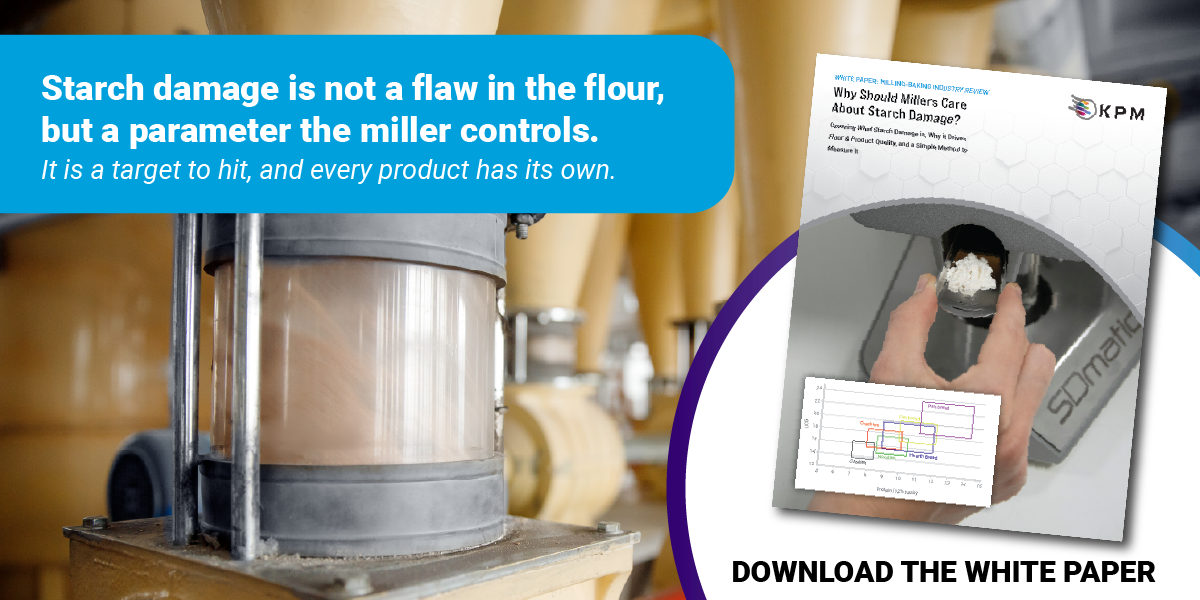
Why Should Millers Care About Starch Damage?
Learn what starch damage is, why it drives flour and finished-product quality, and how to measure it simply.
Starch damage is the one flour quality parameter a mill creates entirely on its own; once it happens, it cannot be undone. From the moment the rolls fracture a starch granule, no amount of blending, storage, or reformulation will change it.
Starch damage is also one of the most predictive numbers a mill lab can produce, correlating strongly with water absorption, dough rheology, and how the flour will perform in the baking process.
In this white paper, Arnaud Dubat, Business Development Director at KPM Analytics, explains what starch damage is, why the ideal level depends entirely on the finished product, and how leading mills use rapid, stream-by-stream measurement to map and optimize their milling diagram with the help of automated starch damage analysis – the SDmatic 2.
What you will learn
- Which roll settings have the most influence on starch damage production
- How and why target starch damage content differs across different flour-based product types
- How the amperometric method (SDmatic 2) delivers results in under 10 minutes instead of 45, and how closely it tracks the enzymatic reference method
- A real 16-stream mill map showing exactly where starch damage builds across break, sizing, middlings, and grading passages
- Why tightening the rolls past a certain point adds damage and energy cost without adding flour yield
- A documented case where starch damage monitoring detected a roll misalignment two weeks before conventional controls