Back to Flour: How Important Is Starch Retrogradation?
Starch retrogradation is the process by which gelatinised starch molecules reassociate and crystallise as they cool, altering the texture and structure of the finished product. It is a natural aging process, and it plays a key role in food science by influencing the firmness, shelf life, and quality of starch-based products such as bread and noodles. As the starch solution cools, amylose and amylopectin chains realign toward a crystalline structure, producing a more rigid, gel-like result. During storage, this bonding continues, increasing firmness and driving water loss through syneresis, which is what leads to bread staling and a firm or rubbery texture in noodles.
Its influence is not uniform across products. Retrogradation strongly affects bread staling and crumb softness, while having a more moderate effect on tortilla flexibility, noodle elasticity, and cracker crispness. Because it is a natural process, it cannot be avoided entirely, though solutions such as reheating, modified starches, and additives can help mitigate its impact.
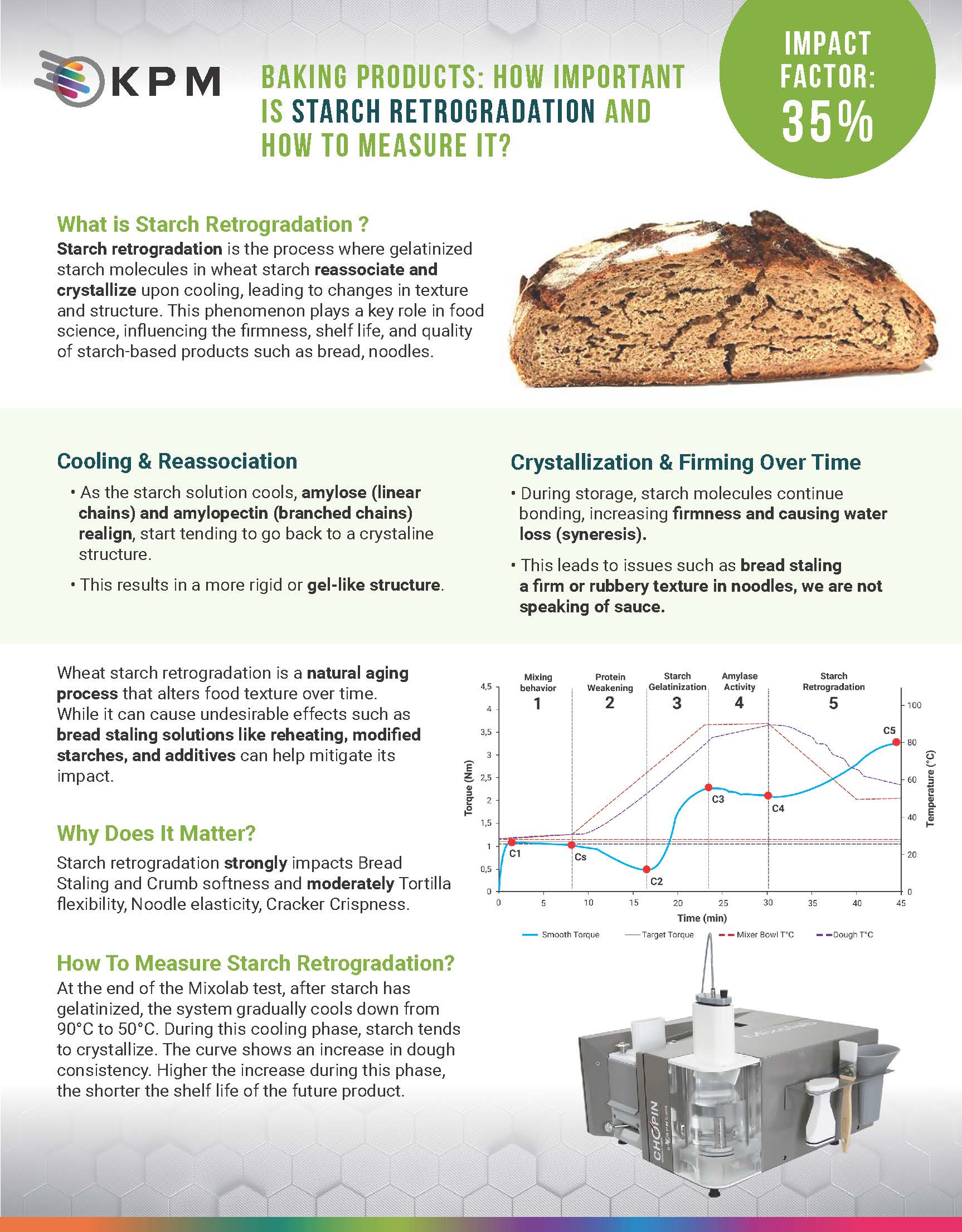
Measurement relies on the Mixolab. Once the starch has gelatinised, the system gradually cools from 90°C to 50°C, and starch tends to crystallise during this phase. The curve then shows an increase in dough consistency: the greater the rise during cooling, the shorter the expected shelf life of the future product.
This document is part of the Back to Flour Series, an educational program that connects flour science to bakery product characteristics. Learn more here.