Revolutionizing Food Safety with AI in IQF Production

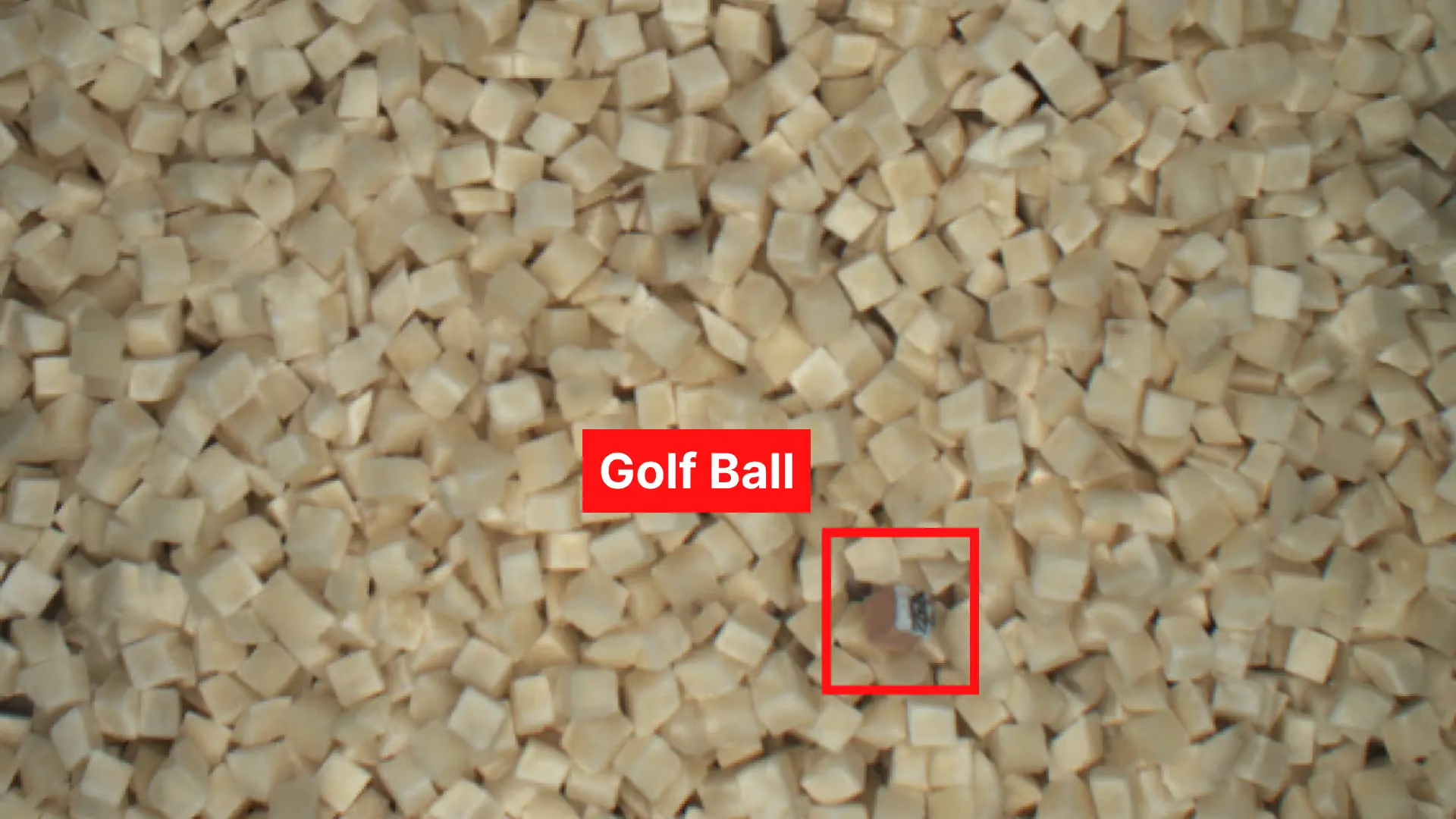
The food industry is undergoing a technological transformation, and nowhere is this more evident than in Individually Quick Frozen (IQF) production. Manufacturers are turning to artificial intelligence (AI) to address longstanding challenges in food safety, quality control, and operational efficiency. We demonstrate AI is reshaping IQF production and why forward-thinking food manufacturers are making the investment now.
What Is IQF Process and Why Does It Matter?
IQF technology freezes individual pieces of food whether fruits, vegetables, seafood, or poultry separately and at extremely rapid speeds, rather than freezing them together as a solid block. This process preserves the texture, flavor, nutritional value, and appearance of each piece, making IQF products highly desirable for both retail and foodservice markets.
However, the very characteristics that make IQF products unique also introduce significant production challenges:
- High variability in raw materials: Fruits and vegetables vary in size, and surface characteristics, making consistent quality control difficult.
- Foreign material contamination risk: Stones, stems, pits, and other foreign objects can easily enter the product stream during harvesting and processing.
- Speed and volume: IQF lines operate at extremely high throughputs, leaving little time for manual inspection.
- Regulatory compliance: Food safety standards such as FSMA, HACCP, and GFSI require rigorous documentation and traceability demands that are difficult to meet with manual processes alone.
These challenges create a compelling case for smarter, faster, and more reliable inspection technologies and that's precisely where AI steps in.
How AI Enhances Food Safety and Quality in IQF Facilities
Modern AI-powered inspection systems use a combination of machine learning, computer vision, and advanced sensor technologies to detect defects, contaminants, and quality deviations in real time at speeds far exceeding what human inspectors can reliably achieve These systems are typically deployed using validated performance criteria specific to the application, ensuring alignment with food safety and quality requirements.
Real-Time Contamination Detection
One of the most critical applications of AI in IQF production is foreign material detection. Traditional optical sorters rely on predefined color or shape thresholds, which can struggle with complex, variable product streams. Often operators must frequently adjust the machine settings to account for differences between production lots, which can slow production and introduce inconsistency. AI-driven systems, by contrast, can be retrained with new data, becoming more accurate over time when properly maintained. They can identify a range of contaminants including stones, glass, and plastic
Below is an image of a piece of a shell detected in clams before freezing
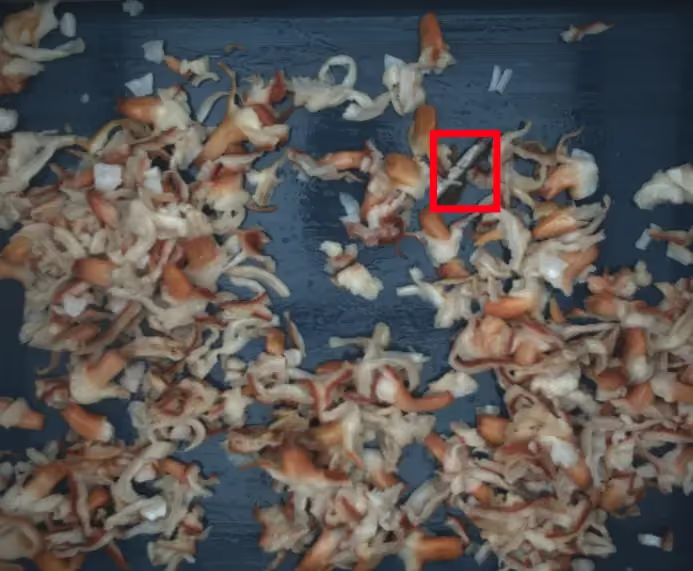
At KPM Analytics, our inspection solutions leverage advanced imaging and spectroscopic technologies to deliver highly accurate, high-speed detection across a wide range of IQF product types.
Consistent Quality Grading at Line Speed
Beyond contamination, AI systems can assess product quality attributes such as color, size, shape, and surface defects and make real-time grading decisions. This enables manufacturers to maintain consistent product specifications without slowing down the line or relying on subjective human judgment.
Key Benefits of AI in IQF Production
Implementing AI technologies in IQF facilities delivers measurable benefits across multiple dimensions of the operation:
- Labor reduction: AI-powered inspection systems can replace or supplement multiple manual sorting stations, reducing labor costs and mitigating the impact of workforce shortages, a persistent challenge in food manufacturing.
- Improved accuracy: Machine learning models detect defects and contaminants with greater consistency than human inspectors, reducing both false positives (good product rejected) and false negatives (bad product passed).
- Data-driven decision making: Every inspection event generates data. Over time, this data reveals patterns such as recurring contamination sources or seasonal quality shifts that can inform process improvements upstream.
- Regulatory compliance and traceability: AI systems create detailed digital records of every inspection, providing the audit trails required by food safety regulators and certification bodies.
- Reduced waste and recalls: By catching defects earlier and more reliably, AI systems help manufacturers reduce product waste and minimize the risk of costly recalls.
The ROI Case for AI in Food Manufacturing
For many food manufacturers, the question is not whether AI works it's whether the investment is justified. The answer, increasingly, is a clear yes.
Consider the cost of a single product recall: according to industry estimates, the average food recall costs a company upward of $10 million when factoring in lost product, regulatory penalties, brand damage, and legal liability. A single AI-powered inspection system that prevents even one recall can deliver a return on investment many times over.
Beyond recall prevention, the ROI equation includes:
- Labor savings: Reducing manual inspection headcount or redeploying workers to higher-value tasks.
- Yield improvement: More accurate sorting means less good product is discarded as waste.
- Throughput gains: AI systems operate continuously without fatigue, enabling higher line speeds and greater output.
- Insurance and compliance benefits: Demonstrable food safety investments can support risk reduction efforts and help simplify regulatory audits.
How Data Collected by AI Informs Better Food Safety Practices
Perhaps the most underappreciated benefit of AI inspection systems is their role as data engines. Every scan, every rejection, and every quality measurement contributes to a growing dataset that can be analyzed to:
- Identify trends in contamination frequency by time of day, shift, or raw material supplier.
- Correlate incoming raw material quality with finished product defect rates.
- Predict and and reduce the likelihood of quality failures before they reach the consumer.
- Support continuous improvement initiatives with objective, quantitative evidence.
This shift from reactive to proactive food safety management is one of the most transformative aspects of AI adoption in IQF production. Rather than responding to problems after they occur, manufacturers can leverage real-time data to make timely decisions that reduce product waste while enhancing both quality and food safety.
Overcoming Common Misconceptions About AI in Food Safety
Despite the clear benefits, some manufacturers remain hesitant. Here are a few common misconceptions and the reality behind them:
- "AI is too complex to implement." Our modern AI inspection systems are designed for integration into existing production lines, with intuitive interfaces and vendor support for setup and training.
- "AI will replace our workforce." In practice, AI augments human capabilities rather than replacing them entirely. Workers are freed from repetitive, physically demanding inspection tasks and can focus on higher-value roles.
- "Our product is too variable for AI to handle." This is precisely where AI excels. Unlike rule-based systems, machine learning models are designed to handle variability and improve with exposure to diverse product streams.
- "The upfront cost is too high." When total cost of ownership is considered including labor savings, waste reduction, and recall risk mitigation AI inspection systems typically deliver strong ROI within a relatively short payback period.
The Future of IQF Production Is Intelligent
As food safety regulations tighten and consumer expectations rise, the pressure on IQF manufacturers to deliver safe, consistent, high-quality products will only increase. AI-powered inspection and quality control is no longer a future-state aspiration; it is a present-day competitive necessity.
At KPM Analytics, we are committed to helping food manufacturers navigate this technological evolution with solutions that are accurate, reliable, and built for the realities of high-speed food production. To learn more about how our technologies can support your IQF operation, contact our team today
.webp)
.avif)