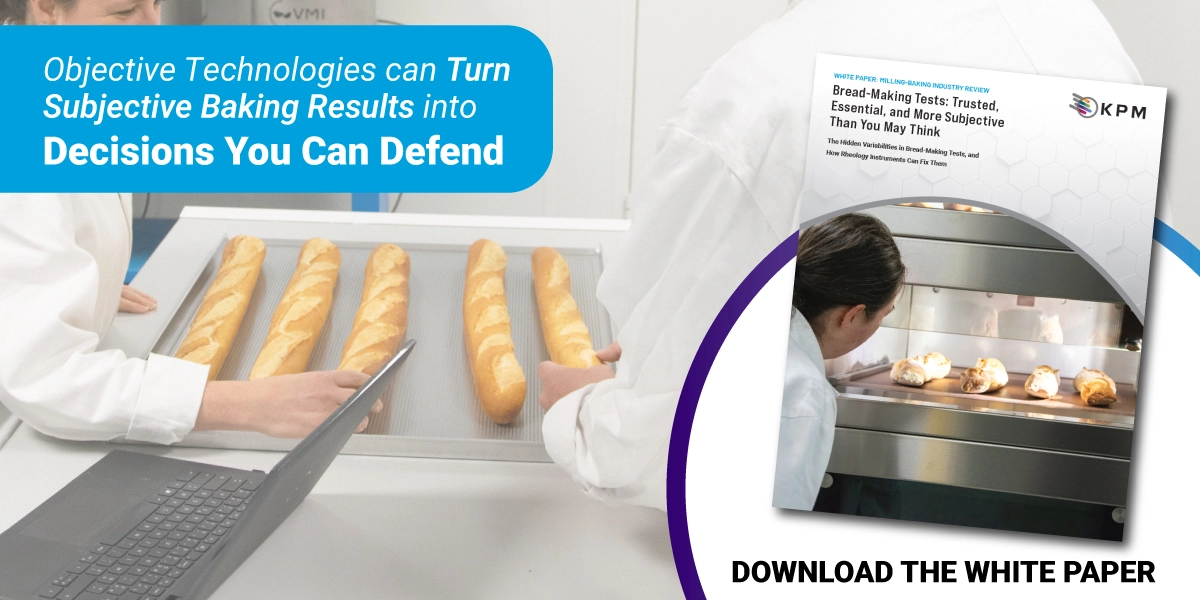
Bread-Making Tests: Trusted, Essential, and More Subjective Than You May Think
Your Bread-Making Test Tells You What. It Doesn't Tell You Why.
For generations, the bread-making test has been the final word on flour quality. You can touch it, smell it, break it apart, and taste it; no simulation, no calculation. But that same strength hides a weakness: the test baker only ever sees the result, not the reason behind it. When a loaf falls short, the explanation comes down to judgment and experience.
This white paper documents a controlled study in which two accredited labs baked the same commercial flour under the same French standard (NF V03-716) and produced results that barely resembled one another.
The paper shows how pairing the bread-making test with objective rheological data gives test bakers, millers, and buyers a reliable reference point for the moments when human-interpreted results disagree.
What's inside
- A side-by-side case study of two accredited labs testing identical flour, and why one set of results proved reliable while the other did not
- How operator expectation — not oven, ingredient lot, or humidity alone — drives much of the variability in bread-making test interpretation
- Where three rheological measurements (dough strength and extensibility, full mixing-and-heating behavior, and starch damage) add objectivity, repeatability, and comparability the baking test cannot supply on its own
- A practical decision framework: what to do when rheology and baking results agree, and what their disagreement is actually telling you
📩 Download this white paper by filling out the form on this page.