Consistency Is the Brand: Why Human Inspection Alone Can't Hold the Line in Baking and Snacks

In baking and snacks, consistency is not a nice-to-have. It is the brand. A shopper who picks up your product expects it to look the same today as it did the last time, and the time before that. Every unit that falls short of that expectation chips away at the trust your marketing works hard to build. The hard part is that consistency has traditionally rested on one of the most variable inputs in the plant: human judgment.
Why “Acceptable” Keeps Drifting
In most baking and snack operations, final quality is judged by a human inspector positioned near the end of the line. It is monotonous work that demands constant attention while hundreds to thousands of units pass by every minute. And because the role is ultimately subjective, different employees apply different acceptance criteria for what counts as a quality product. What one inspector waves through, another pulls. That variation is not a training failure. It is the built-in limit of asking people to make the same fine judgment, the same way, thousands of times an hour across every shift.
The result is a standard that quietly drifts by inspector, by shift, and by how tired the line is at hour seven. In a category where the look of the product is the promise of the brand, a drifting standard is a drifting brand.
Turning the Spec into a Number Everyone Shares
Vision inspection removes the subjectivity by making the standard explicit. Rather than living in each inspector's head, the acceptance criteria become measurable tolerances the system applies identically to every unit. Systems today can quantify key attributes such as 2D shape, 3D height and volume, bake color, and topping coverage, and can inspect both the top and the bottom of a product without turning it over.
Just as important is how that standard gets set. The final quality specification is typically negotiated between the bakery's QA and production teams and then agreed with the customer, and the system uses that agreed spec as its parameter for pass or fail. Consistency stops being one person's opinion and becomes a shared definition that the QSR buyer, the plant, and the line all point to. When a customer audit asks how you enforce quality, the answer is a documented, objective threshold rather than “our inspectors know it when they see it.”
Moving From Rule-Based to AI Inspection
Most systems in place today use rule-based analysis: the operator programs specific tolerances for each measurable trait, and it works well for straightforward pass/fail checks before packaging. AI-powered systems go a step further by learning from large sets of labeled images of acceptable and unacceptable product, which lets them hold a consistent standard on the judgment calls that used to require a person.
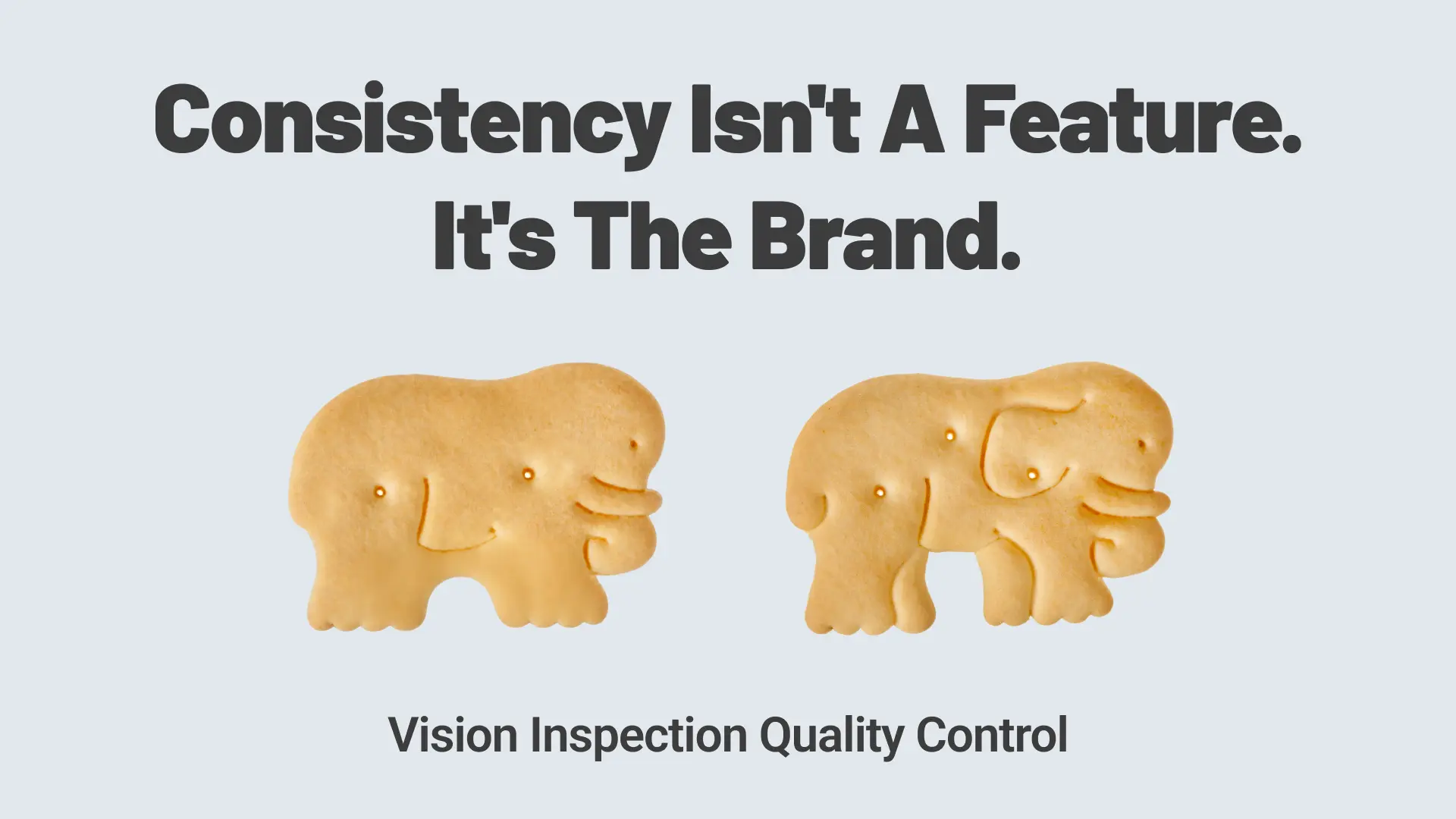
Consider an animal cracker line, where every cracker is supposed to carry the detailed features of a specific animal. An AI system first discerns which animal the cracker is meant to be, then determines whether it is missing any features and to what degree. If an elephant has lost its trunk or a bird its beak, the system makes that call faster and more consistently than an average inspector, and the baker can tune exactly how severe a defect must be before it is rejected. That is shape-and-feature consistency enforced identically on every unit, not sampled here and there.
Knowing Features vs Flaws
The most common way consistency checks go wrong is over-rejection: flagging normal product as defective. A hamburger bun, for instance, is baked to a consistent golden brown but is still expected to show some white speckling, especially on the bottom. A blunt rule can read that natural feature as a defect and pull good product.
This is where AI has advanced the most. Trained over time, these systems can separate genuine defects and foreign material from natural product features such as dimples and toast marks, even when the unwanted material is a similar color or texture to the product itself, distinguishing, say, caked-on excess dough from an acceptable speckle pattern. Fewer false rejects means less good product wasted and a standard that operators actually trust, instead of one they learn to override.
Catching Drift Before it Becomes a Defect
Consistency is cheaper to protect upstream than to inspect for at the end. Vision Process Control (VPC) places inspection at earlier stages such as after mixing, forming, and proofing, with real-time feedback that can automatically adjust process parameters to keep performance on target, and often helps pinpoint where a problem is originating. Paired with final-product inspection, that gives 100% online inspection: variation is flagged as it emerges rather than discovering it a pallet later. The payoff is straightforward. Fewer defects reach your customers, quality holds to the same objective standard across every shift, and the product looks right every single time, which is where consistency stops being a cost center and becomes a competitive edge.
Ready to turn consistency into a documented, repeatable standard? Let's talk about what it looks like on your line. Click HERE to contact us.
Source
KPM Analytics, “Elevating Food Safety in Baking & Snack Food Plants” (white paper)
Yes, we have interfaced to a variety of systems for real-time data collection and reporting. We also offer real-time process monitoring dashboards.
Vision inspection systems can detect a variety of defects, including discoloration, foreign objects, missing pieces, and misshapen products.
Every detection is logged with an image and is filterable by defect type, production window, and shift, producing defensible records for audits and complaint investigations. Detection trending also shows where FM enters the process (by shift, source, or supplier), supporting the preventive, evidence-based approach that FSMA, SQF, and major grinding customers increasingly expect.