The Evolution of Wheat Flour Quality Control for a Changing Industry


Wheat flour quality control has shifted dramatically over the past century, moving from purely sensory baking trials to data-driven instrumentation that connects the miller, baker, and bread improver formulator in a single feedback loop. As consumer demands diversify and clean-label expectations grow, modern flour producers and bakeries depend on wheat flour quality control methods that can keep pace with enzyme-based formulations, ancient grains, gluten-free products, and frozen dough applications. This post traces the development of laboratory equipment for flour testing how laboratory equipment for flour testing developed alongside milling and baking, what tools like the Rheofermentometer reveal in a commercial baking lab, why enzyme-based bread improvers are reshaping formulation strategies, and how producers can check wheat flour quality with confidence today. Throughout, KPM Analytics offers solutions built to support every stage of bakery production quality control.
What is the History of Laboratory Equipment Used for Wheat Flour Quality Control?
The history of laboratory equipment used for wheat flour quality control follows the broader transformation of milling and baking from artisan craft to industrial process. Before 1900, baking itself was the only meaningful quality test. Stone milling produced coarser, darker flours, and bakers relied on hands-on experience rather than wheat flour quality control instruments. The shift began with roller mills, first developed in Switzerland and Austria between 1830 and 1850 and adopted widely after Hungarian millers installed the first complete roller mill system in Budapest in the 1860s. By 1880, Minneapolis had become the milling capital of the world, and by 1930, roller mills dominated globally.
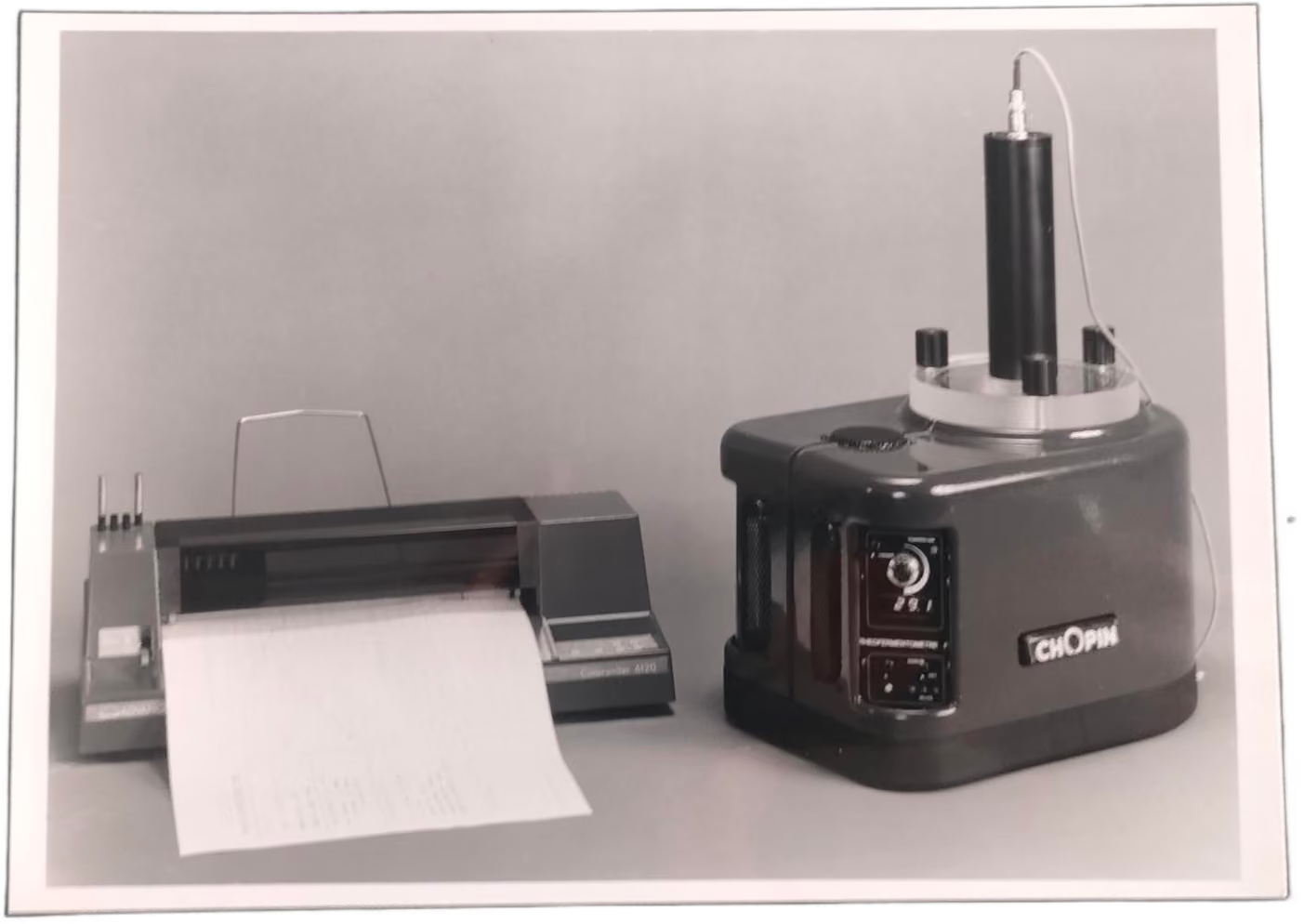
The first edition of the AACC Standard methods, released in 1916, covered basic chemical and physical analyses such as moisture, ash, protein by Kjeldahl, gluten, and sedimentation. The Alveograph arrived in the early 1930s, and the Zymotachygraph, an ancestor of today's Rheofermentometer, was introduced in 1950. The Petrinex, an ancestor of the Mixolab, appeared in the 1960s, the same period that saw the Alveograph become an official ICC method in 1966 and the founding of the BIPEA proficiency testing program in 1970. Bakery laboratory equipment continued to advance with the Rheofermentometer in 1994, the Consistograph in 1999, and the Mixolab in 2005, which became an ICC standard in 2006 and an AACC standard in 2007. The Mixolab 300, launched in 2025, represents the most recent step in flour testing instruments, designed to analyze dough drawn directly from production lines.
What Does a Rheofermentometer Measure in a Commercial Baking Lab?
A Rheofermentometer measures the behavior of dough during the proofing stage, providing a commercial baking lab with detailed information on how a flour and its associated formulation perform under fermentation conditions. Specifically, the Rheofermentometer tracks dough development (height and volume changes over time), gas production by yeast, and gas retention within the dough matrix. These three curves together reveal whether a dough will rise predictably, hold its structure, and deliver the expected loaf volume in production.

For a commercial baking lab focused on wheat flour quality control, the Rheofermentometer fills a gap that protein content and gluten quantity alone cannot address. A flour can meet specifications on paper and still underperform during proofing because of enzyme activity, starch damage, or interactions with bread improvers. The Rheofermentometer was first introduced in 1994 by CHOPIN Technologies, now part of KPM Analytics, and became an AACC standard method in 2001. In day-to-day quality control, the instrument is used to:
- Verify the consistency of incoming flour lots before they reach production
- Evaluate the impact of yeast levels, salt, sugar, and bread improver dosing on dough behavior
- Troubleshoot fermentation issues such as excessive gas loss or underdevelopedunder-developed dough
- Support new product development for sourdough, frozen dough, and high-sugar formulations
By generating reproducible curves rather than subjective observations, the Rheofermentometer gives a commercial baking lab the data needed to predict how a flour and formula will behave on the production floor. KPM Analytics offers process control solutions for bakery production that complement laboratory testing with real-time monitoring of finished products.
Why are Modern Bakeries Switching to Enzyme-Based Bread Improvers?
Modern bakeries are switching to enzyme-based bread improvers because consumers, regulators, and retailers increasingly demand clean-label products without synthetic additives such as potassium bromate, which has already been banned in many markets. Enzyme-based bread improvers, which include xylanases, amylases, lipases, and proteases, deliver the dough strength, volume, crumb softness, and shelf life that bakeries previously achieved with chemical oxidizers and emulsifiers, but they do so using ingredients that can be declared as processing aids in many jurisdictions.
The shift toward enzyme-based bread improvers also reflects the diversification of bakery products. Frozen dough, gluten-free formulations, ancient grain breads, and high-fiber loaves each demand specific enzyme combinations to manage starch, gluten, and pentosan behavior. A bread improver built around xylanase improves water binding in whole wheat applications, while specific amylases extend shelf life by slowing starch retrogradation. This level of precision was not possible with the early oxidizers and malt enzymes that emerged between 1945 and 1960.
Enzyme-based bread improvers do introduce new wheat flour quality control challenges. Their effects on dough rheology are sensitive to mixing time, hydration, and temperature, which means traditional flour specifications no longer capture everything a baker needs to know. Bakery laboratory equipment must evolve in parallel to measure not only the flour itself but the way the flour, water, yeast, and enzymes interact across mixing, shaping, proofing, and baking.
How to Check Wheat Flour Quality?
To check wheat flour quality, producers and bakers combine basic compositional analysis with rheological testing and finished-product inspection, building a wheat flour quality control program that covers everything from incoming wheat to the loaf leaving the oven. A complete check typically includes the following layers:
- Compositional analysis covering moisture, ash, protein, gluten quantity, and falling number to confirm the flour meets baseline specifications
- Starch damage measurement, since damaged starch granules absorb more water and influence dough hydration, fermentation, and final product quality
- Rheological testing using instruments such as the Alveograph, Consistograph, Mixolab, and Rheofermentometer to characterize dough strength, extensibility, mixing behavior, and fermentation performance
- Application or baking tests that confirm how the flour performs in the actual product, whether baguette, pan bread, ciabatta, cake, or frozen dough
- Finished-product inspection on the production line to verify color, dimensions, structure, and the absence of foreign material
Checking wheat flour quality today is no longer a single test but an integrated workflow. Bakery laboratory equipment from KPM Analytics, paired with vision inspection on the production line, gives millers and bakers the data they need to manage clean-label formulations, enzyme-based bread improvers, and diversified product lines without sacrificing consistency.
Download the Whitepaper
Written by KPM Analytics' Global Business Development Director, Arnaud Dubat, the whitepaper explores the over 125-year evolution of the four essential players (millers, bakers, bread improvers, & lab equipment) of the grain-flour-bread chain had to grow from an artisanal/local bakery industry into the industrial powerhouse baking brands we all know today.

.avif)