Three Foreign Material Detector Technologies, Three Blind Spots

Ask a quality manager at a high-volume bakery what protects their product from foreign material, and, if they’re using technology beyond manual inspection, you might hear the same two answers: the metal detector and the X-ray. Both are well established, both are validated, and both do exactly what they were designed to do.
The problem is what they were designed to do.
A metal detector asks one question of every product that passes through it: Does this conduct or disturb a magnetic field? An X-ray asks a different question: Is there something here that is denser than the surrounding material? Both are good questions for catching broken blade fragments, wire, bone, stone, glass, and similar higher-density materials. They are the right tools for those hazards, and nothing here suggests otherwise.
But consider what actually ends up in a bakery or snack process:
- A torn corner of a blue nitrile glove
- A shred of polyethylene from a bag liner
- A piece of cardboard from an ingredient carton
- A strip of conveyor belt
- A splinter of wood off a pallet
- A rag
None of those objects conduct, and none of them are appreciably denser than a proofed bun or a topped pizza. They pass through both systems without being registered and, in many cases, end up sitting in plain view on the product's surface.
That is the gap. And it’s the gap that inline vision inspection was built to close.
Why "Just Look At It" Has Never Been Good Enough
Human inspection is the traditional answer to surface defects, and it does not scale. A line running at 1,000 units per minute across three shifts asks an inspector to make thousands of accept-reject decisions per hour on a monotonous task, with attention that inevitably drifts. Even with thorough training, the criteria are subjective, meaning they vary among employees and within a single shift. Two inspectors looking at the same bun frequently disagree about whether it ships.
Machine vision removes the subjectivity and inspects every unit, top and bottom, at full line speed. That much has been true for years, and many bakeries already run rules-based vision systems for dimensional and color control.
What has held vision back as a foreign material tool is something subtler, and it is worth naming directly.
The Tolerance Problem
Rules-based vision works by having an operator set numeric limits for each measurable trait. That works beautifully for length, width, height, and bake color, where the target is a number and deviation is a number, and the food products are highly consistent from one to the next.
It works far less well for foreign material, because most baked goods are naturally irregular. A hamburger bun is supposed to have white spots on the bottom. A cookie is supposed to have toast marks and surface variation. A seeded roll has a different scatter on each unit. A glazed product introduces shine that can confuse the image.
So the quality manager setting tolerances faces a choice with no good answer. Set the limits tight enough to reliably flag a dark rubber fragment, and the system also flags every burnt sesame seed and every normal dimple, generating false rejects and waste until someone on the floor loosens the settings to keep the line running. Set them loose enough to avoid nuisance rejection, and a genuine contaminant of similar color or size passes through.
Every bun has spots. The question rule-based vision cannot answer is which ones are flour and which ones are rubber.
What AI-Powered Inspection Changes
AI-based vision approaches the problem differently. Rather than applying numeric limits trait by trait, the system is trained on large sets of labeled images showing what an acceptable product looks like, what known defects look like, and what common foreign materials look like in that specific process.
That training lets the system assess shape, texture, and context together rather than color alone. In practice, it means the system can separate caked-on excess dough on the bottom of a bun from the normal surface variation surrounding it, or distinguish a pepperoni slice from a similarly colored piece of red pepper by considering its edges and texture rather than its hue.
Models can be retrained as new defect types emerge in a process, which matters when a plant changes suppliers, adds a product, or begins to see a new failure mode from aging equipment. Retraining is a deliberate, documented step, not something that happens quietly in the background, which is exactly what a quality system requires of any control measure.
Three Technologies, Three Different Questions
Advancements in vision inspection technology have pushed what inline systems can resolve to well below a millimeter, and that resolution applies to every surface of the product, not just the one facing up. Cameras positioned to view the underside have been standard on these systems for years, so both surfaces of every unit are inspected in-line, with no handling or flipping. That matters more than it sounds. The underside of a bun or a biscuit is where pan residue, encrusted dough, and material picked up off equipment tend to collect, and it is the surface a human inspector is least likely to check.
Lay the three technologies side by side, and the case for running them together becomes clear:
- Metal detection asks whether it conducts.
- X-ray asks whether it is dense.
- Vision asks what it looks like, in fine detail, on every surface of every unit.
Three different physical principles mean three genuinely independent blind spots. A contaminant has to get past all three. That is the argument for layering rather than substituting, which is why replacing a metal detector or X-ray with a vision system, and vice versa, would be a mistake.
Hyperspectral Imaging
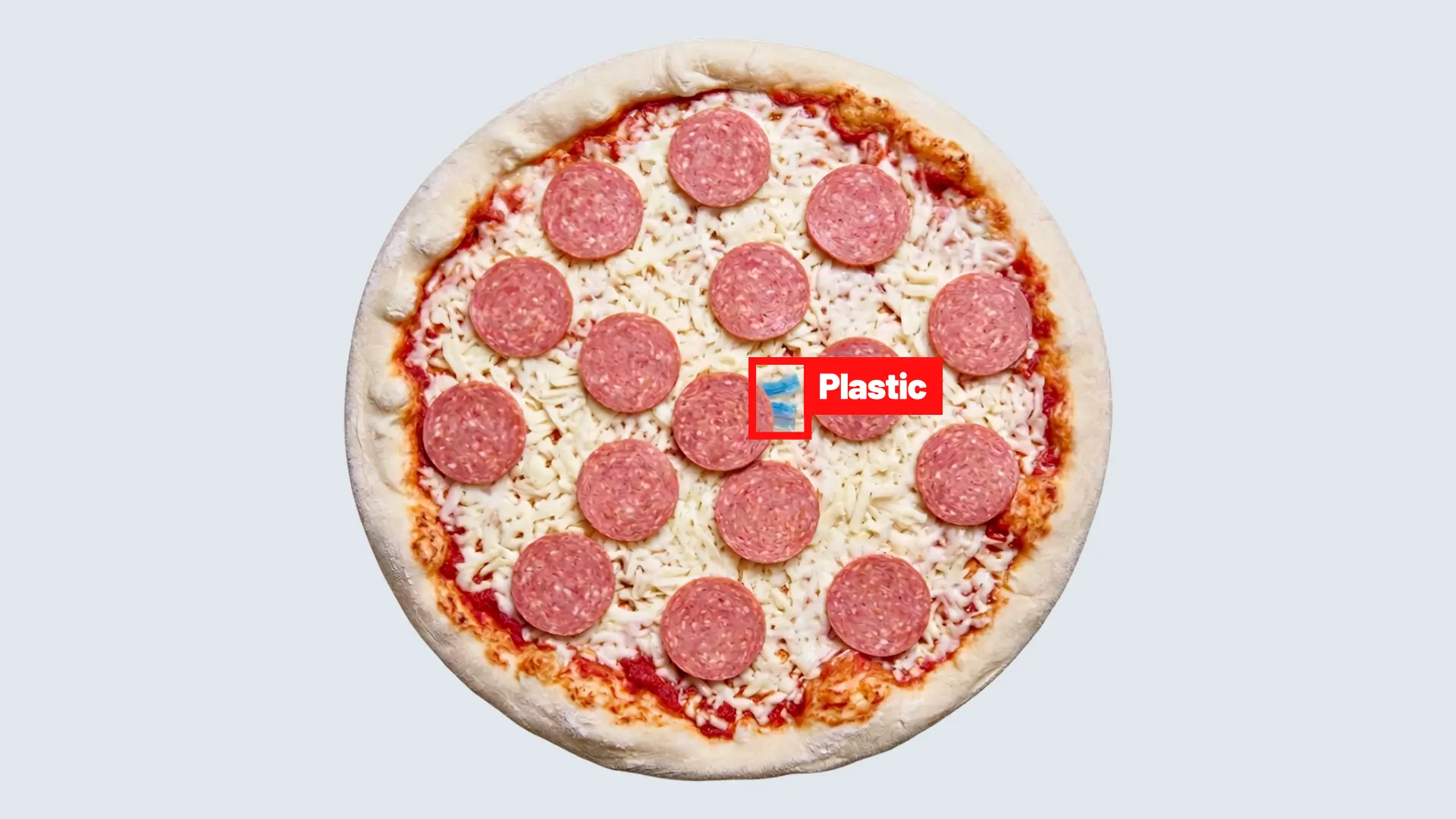
Short-wave infrared hyperspectral imaging is also an option for inline inspection. Rather than reading how a material looks, hyperspectral imaging reads how it absorbs light across wavelengths outside the visible spectrum, which reflects what the material is chemically made of. In our own testing on topped pizza, the approach separated paper, wood, and plastic from the product surface, including materials that closely resemble the product in visible light. If your process is dominated by contaminants that defeat color-based inspection, hyperspectral imaging is worth a conversation.
The Honest Limits
No foreign material detection method is foolproof, and any vendor who tells you otherwise is selling rather than engineering.
Vision inspects surfaces. It sees the top and the bottom of a product, but it does not see through the crumb. A low-density fragment folded into dough before baking remains the hardest case in the industry, and it is hard for every technology, because X-ray is weakest exactly where density contrast is lowest. Detection performance for any given contaminant must also be established for each product and material through seeded trials, since there is no universal test piece for optical inspection.
Stated plainly: Layered inspection tech gives you the broadest practical coverage across contaminant types.
What This Means for Your Program
Where inline vision fits in a food safety plan is determined by the site through its own hazard analysis and by its auditor. What KPM can tell you is that the system produces the kind of evidence those programs run on: every unit inspected rather than a periodic sample, statistical trending on defects and rejects, exportable reports, and a logged record of who changed an inspection criterion and when.
That last point tends to matter more than people expect. When an auditor asks how you know your controls held last Tuesday, the answer needs to be a record, not a recollection.
Where to Start
If you already run metal detection and X-ray, you have well covered the dense and conductive hazards. The productive question is what your current program does to address the low-density surface contaminants that neither system was built to detect, and whether your line is one where that risk is real.
That question is easier to answer if we can see what you’re dealing with, rather than in the abstract. Connect with us to send images of the contaminants you have actually found, tell us where on the line they appear, and our application team will tell you candidly whether inline vision is likely to catch them on your product.
KPM is well entrenched in the baking industry. We help companies throughout their process - from determining flour quality and developing products, to inspection of finished goods. Our vision systems run in hundreds of food production facilities globally.
Connect here to start an application review with KPM’s experts.
No. Vision inspection is a complementary technology, not a replacement for your existing CCPs. Metal detection and X-ray remain the right tools for dense and conductive contaminants; AI vision closes the gap on low-density, visible foreign material that density-based systems cannot see.
Yes, in most cases we can customize an Over-Line or In-Line system to work with your existing configuration. To be sure, reach out and discuss your ideas with our specialists using the form on our contact page.
Vision inspection systems can detect a variety of defects, including discoloration, foreign objects, missing pieces, and misshapen products.