How Emmi Desserts Transformed Its Process Control with Mixolab
Producing 600 million units of the same pastry product each year on several lines requires a high degree of consistency. For Emmi Desserts, Mixolab helps reduce gaps with data to cut waste, accelerate product development, help and empower operators.
Emmi Desserts is an industrial bakery group that produces and markets an expansive range of pastries, having joined the Emmi group at the end of 2024. The 21 industrial pastry sites of the Emmi group are spread across Europe (France, UK, Benelux, Italy) and the United States. Their products are sold on every continent.
At the heart of this operation, the R&D pastry team oversees improvement programs of the products. For Franck Corlay, Group Product Director for Emmi Desserts, improving product consistency and repeatability across their production lines is a permanent objective.
Bridging Quality Gaps Between Lines
With several high-volume production lines running in parallel, all dedicated to manufacturing the same product, Mr. Corlay and his team frequently face a familiar industrial reality: product variability. Product quality can fluctuate from one line to another, with causes that are not always identified and solutions that could be improved.
“In baking, when a dough is not meeting its desired consistency, the first thought may be to modify the water quantity or change the mixing time. But in an operation like ours, this approach can prove counterproductive,” says Mr. Corlay.
Mr. Corlay and his team identified a clear need: To move away from trial-and-error and the tendency to manage their process by instinct rather than objective data and build a quality control framework that anyone on the production floor could follow with confidence.
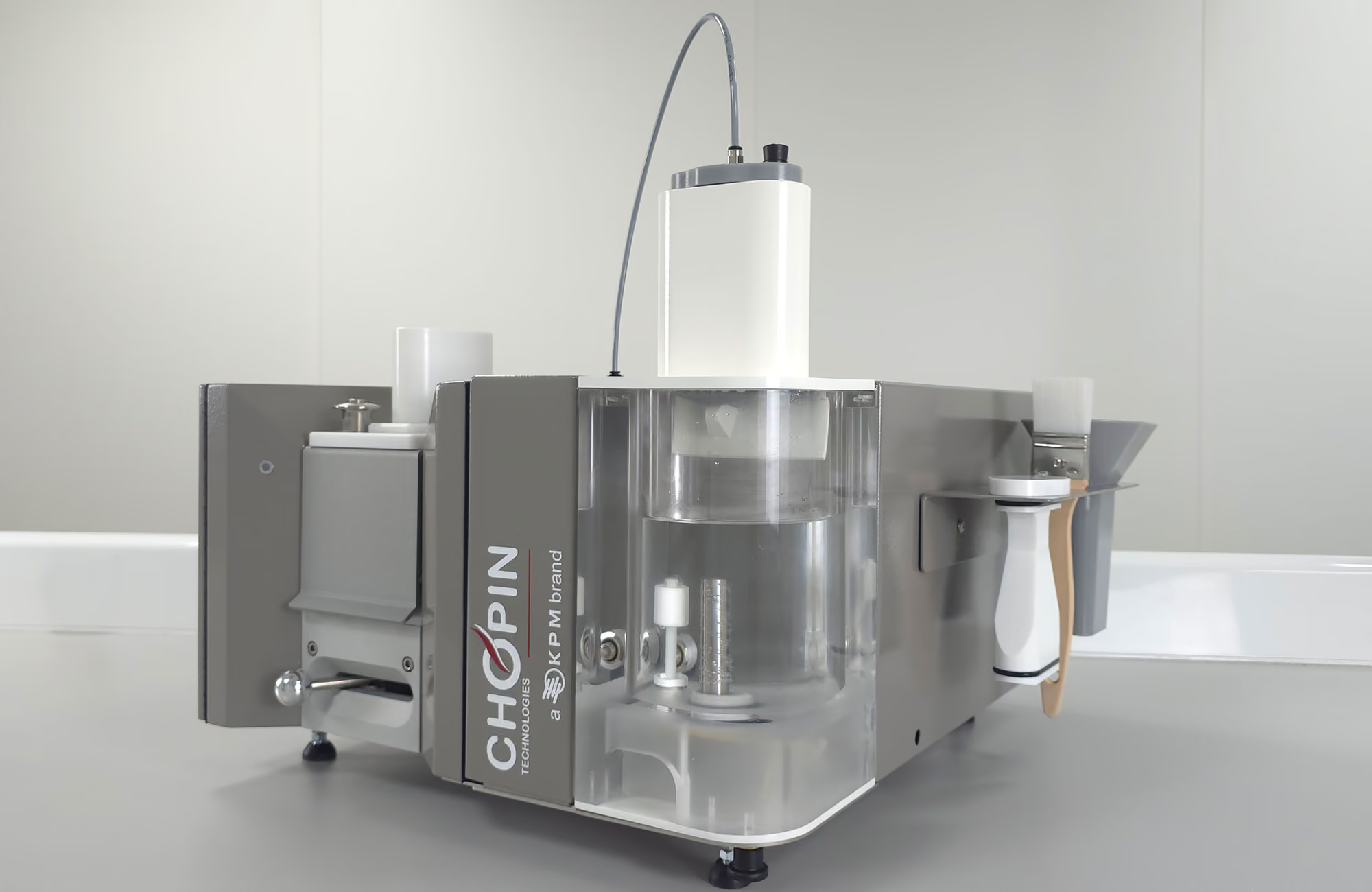
It is important for Mr. Corlay and his team to be proactive rather than reactive when challenges occur on the line. He therefore set out to find a tool to help better understand the causes of the observed variations. He eventually discovered the Mixolab Universal Dough Analyzer, a fully automated system that simulates the baking process, including mixing, heating, and cooling, to assess functional interactions of starch, proteins, enzymes, and other components.
Characterizing Both Flour and Dough
Emmi Desserts chose Mixolab as the analytical backbone of a dual approach, characterizing raw materials upstream and monitoring dough behavior during the process itself.
On the flour side, Mixolab allows the team to target the optimal hydration level for each batch, qualify flour at the start of a production day, which is particularly important when harvest transitions affect incoming quality, and maintain a data-driven dialogue with suppliers. “If flour is non-compliant with persistent deviations, the supplier is contacted,” Mr. Corlay notes. “Mixolab gives us the language to have that conversation.”
On the dough side, the instrument is used to understand and refine the kneading conditions—particularly temperature and time—with the responsiveness needed to keep production on track. “These are two key and interdependent steps,” explains Mr. Corlay. “Measuring both allows for better control over the repeatability of the product’s behavior.”
The Turning Point: Product Profiles as an Objective Guide
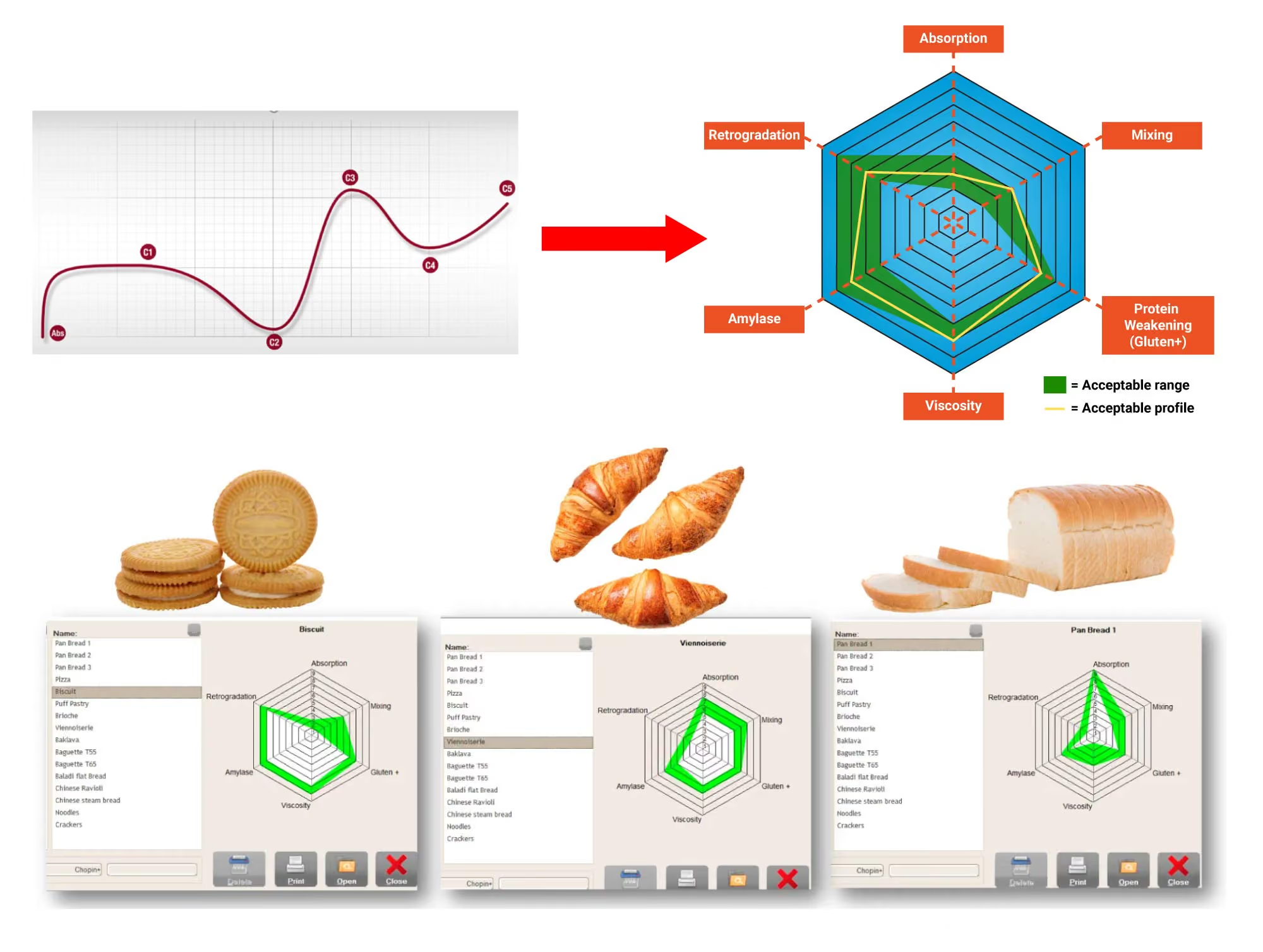
As Mr. Corlay explains, one of the values of Mixolab is how it allows a reference framework to be established for the company’s unique products, a feature called the Mixolab Profiler (explained in Figure 1, profiles sourced from KPM Analytics).
“Mixolab helps us create a flour quality target by comparing flour testing results with retrospective data of flours that we know will yield an ideal final product. We can then take the necessary steps to adjust the process to correct quality variations before starting production, helping us save time, reduce ingredient losses, and feel more confident in our decision making.”
— Franck Corlay, Group Product Director, Emmi Desserts
Accelerating Product Development
Beyond process control, the Mixolab has significantly reshaped how Emmi Desserts approaches new product development. Working against a known target curve means the team is no longer developing blind. Formulation work, like adjusting sugar-to-egg ratios in cake doughs, for example, can be largely resolved at the lab bench before moving to full-scale trials.
“With Mixolab, most of our recipe formulation issues are resolved before they even reach the production line. This speeds up the process and minimizes waste of time and raw materials. Industrial trials are reduced, even though they remain necessary.”
— Franck Corlay, Group Product Director, Emmi Desserts
The Results: Less Waste, More Consistency
Mixolab’s economic impact has been significant for the Emmi Desserts quality team. In a fiercely competitive market, reduced variability translates directly into fewer rejected products, lower waste, and a more efficient use of resources.
Asked to quantify the return on investment, Mr. Corlay simply replied: “An excellent investment.” Mixolab is now used daily across the company’s production lines supporting an output of 600 million finished products per year. The team is exploring its application on additional sites for specific use cases.
A Partnership Built on Practical Application
Emmi Desserts commends KPM Analytics for providing application support to elevate their Mixolab system from a data generator to an industrial tool. “Strong involvement and expertise to help us move quickly towards practical application,” Mr. Corlay says. The collaboration was not limited to supplying equipment, it extended to building the analytical methodology that now supports the group’s daily quality management.
Download and share this article:


.avif)