How Europe Snacks Uses Mixolab to Drive Quality and Innovation
Mixolab helps the Europe Snacks daily to bridge the gap between raw material analysis, dough characterization, and industrial performance.
Consistency is in high demand among Europe Snacks customers, which is one of Europe’s largest retail brands specializing in crackers and savory snacks. Achieving consistency at an industrial scale begins in the company’s R&D lab with a tool that has quietly but significantly transformed how Europe Snacks understands its raw ingredients, formulations, and processes.
That tool is the Mixolab Universal Flour & Dough Characterizer.
A European Snack Powerhouse
Founded in 1990, Europe Snacks has quickly grown into one of the most recognizable brands in the European snack market. The company employs more than 2,300 people across seven production sites in France, the United Kingdom, and Spain. The group generates approximately €650 million in revenue, with this product line covering a wide range of products, including chips, extruded and puffed snacks, crackers and stacked chips, all produced for retail and foodservice clients.
Europe Snacks operates out of two manufacturing sites in France, including a dedicated stacked chips and crackers factory in Saint-Denis-la-Chevasse. It is here where Manon Leheup works as R&D projects manager for crackers.
“As R&D project manager, I develop and optimize products to meet the needs and expectations of customers and consumers, while overseeing technical, financial, and regulatory requirements from design to industrialization. I also support production, quality control, and manage knowledge around materials and processes,” says Ms. Leheup.
Moving Beyond Traditional Analysis: Mixolab
Europe Snacks purchased its first Mixolab in 2017. Prior to Mixolab, Alveograph testing was the R&D team’s primary method of flour analysis. Although the test is effective for analyzing dough’s important rheological properties, such as tenacity, extensibility, elasticity, and baking strength, the R&D team felt that relying solely on Alveograph analysis limited their understanding of ingredient quality and process control.
“While the Alveograph provides valuable information, there were different pieces missing from our quality assurance puzzle,” Ms. Leheup says. “We were looking for a device that would allow us to learn more about our flours, including starch content and dough behavior.”
After discovering the Mixolab, its dual capability, flour analysis and dough characterization in one instrument, was a decisive factor. Today, Europe Snacks uses the Mixolab across three core applications:
- Analyzing the consistency of production doughs and comparing them against established targets
- Characterizing flours and monitoring harvest-related variations
- Studying the impact of adding specific ingredients to flour
Building a Database of Dough Knowledge
According to Ms. Leheup, one of the unique values of the Mixolab is its ability to maintain a data log of dough quality, which can serve as a benchmark for testing doughs directly from the production line. Most bakeries today manually examine dough by touching and squeezing it to determine its consistency. As this dough quality analysis method is highly subjective, Ms. Leheup has found that the Mixolab can essentially apply “numbers” to what the production team feels from their doughs.
“Because we have amassed so many Mixolab samples of our doughs, we have established an ‘ideal dough curve’ for our various products. Using a Mixolab in the laboratory, our production team can perform a similar test with sample doughs to obtain a data curve to compare against the ‘ideal curve.’ Then, the production team can make process adjustments to change the dough consistency before production begins,” explains Ms. Leheup.
As Ms. Leheup also mentioned, the Mixolab has been instrumental in helping the company develop its comprehensive database of cracker dough consistency targets. Over the years, the Europe Snacks’ R&D team has built reference Mixolab curves for each recipe, establishing clear benchmarks for what an ideal dough looks like.
“When innovating or reformulating a recipe, we compare our new dough formulas to this target (developed with the Mixolab) to predict how they will perform on our production line,” Ms. Leheup explains. “If the Mixolab curve of a dough we’re analyzing differs too much from our control curves, we adjust the consistency before processing it on the line.”
This approach delivers real operational value. Rather than discovering problems once dough is already on the production line, where issues can significantly affect productivity, operator error, and wasted product, the team can identify and correct formulation problems with a simple, fast lab test.
“When it comes to solving industrial problems, Mixolab helps us ensure that the dough meets specifications before entering the production line,” notes Ms. Leheup, “thereby avoiding the difficulty operators face when working with a complicated dough (i.e., productivity) or even waste in cases where the dough has to be discarded. “In terms of procurement support, Mixolab has enabled us to select the raw material with the best cost-effectiveness ratio.”
Uncovering Ingredient Interactions
Mixolab has proven invaluable for helping Europe Snacks understand the complex interactions between ingredients; insights that would otherwise be difficult or impossible to obtain without a full production run.
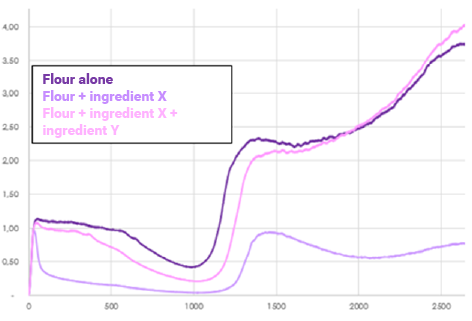
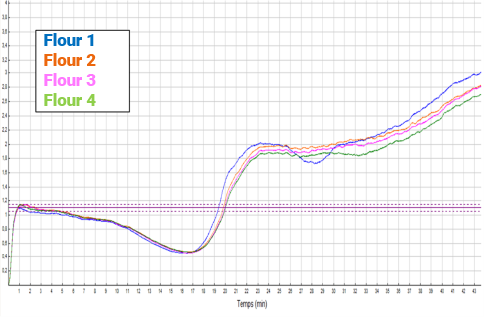
Ms. Leheup shares a revealing example from a recent industrial trial (Figure 1): “We tested ingredient Y, but processing the dough on the production line proved difficult. To understand the issue, we analyzed our flour alone, then our flour combined with ingredient X — which is present in all our recipes — and finally our flour combined with both ingredients X and Y using Mixolab.”
The results told a clear story. “From the curves, we concluded that ingredient Y inhibited the action of ingredient X on our flour. The behavior was very similar to that of the flour alone,” Ms. Leheup recalls. The production team provides the quality team with a scientific explanation for the manufacturing difficulty and a clear path to resolving it.
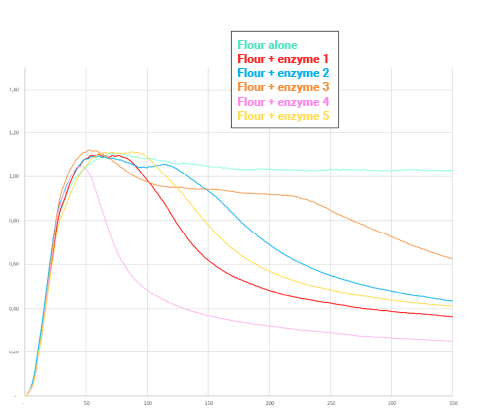
The team has also used the Mixolab for enzyme screening, both to evaluate different enzymes at identical dosages and to validate optimal dosages by comparing results with enzymes already in production. This systematic approach has opened the door to new supplier options, says Manon Leheup.
Fostering Better Communication with Suppliers
The Mixolab also strengthens Europe Snacks’ relationships with its flour suppliers. According to Ms. Leheup, Mixolab provides a common analytical language for discussing quality.
“Along with Alveograph data, Mixolab flour analysis allows us to monitor the quality of our flours and serves as our benchmark for discussions with our suppliers,” Ms. Leheup says. “We compare flours with one another when onboarding new suppliers or switching harvests, thereby anticipating potential issues on the production line.”
This framework, developed by Mixolab, makes conversations about quality more productive and data-driven, helping reduce uncertainty when evaluating new batches, comparing suppliers, or navigating variability that comes with each wheat harvest.
A Tool that Stands Apart
Having evaluated other technologies, Ms. Leheup says Mixolab’s versatility is a truly unique characteristic when compared to other similar rheological instruments. “Mixolab’s main advantage is that it can be used as an R&D tool, unlike other devices on the market, and it offers dual capabilities for both dough and flour.”
At Europe Snacks, every new member of the crackers R&D team is trained in dough and flour analysis using Mixolab.
“Mixolab provides quantitative data, aids in understanding ingredients and interactions between materials, and can be used as output data for experimental designs,” Ms. Leheup says. “It allows for the analysis of flours and provides more information than other flour analysis devices. It is also a hybrid device because it can analyze dough consistency. This analysis is quick and simple, helping resolve industrial challenges. But above all, Mixolab improves our innovative efforts by characterizing and ensuring the reliability of our dough textures.”
A Strong Partner in KPM Analytics
The KPM team offers ongoing support in interpreting analyses and helped Europe Snacks customize dough analysis protocols for specific textures and production needs.
“The various seminars organized by KPM help us stay connected, enrich our theoretical knowledge through training, and share our challenges and issues with other manufacturers,” Ms. Leheup adds, highlighting a community dimension that amplifies the benefits of the technology.
By integrating raw material quality analysis, formulation science, and industrial performance into a single, coherent workflow, Mixolab provides added assurance, helping Europe Snacks ensure product consistency and build brand value.
Download & Share this Success Story