A Process-Driven Quality Assurance Approach

This article originally appeared in an issue of Baking+Biscuit International. Click here to view the article on the publication's website.
Master bakers have been the cornerstone of the baking industry, bringing skill, artistry and knowledge to the baking plant. Their keen ability to observe and quickly determine if the dough was too dry or sticky, did not proof to its ideal form, or detect any minor quality defect that would go unnoticed by an untrained eye, was craftsmanship in its truest form. This experience and attention to detail go a long way in cultivating customer loyalty. They became the foundation for the growth of some of the world’s most iconic baking and snack food brands.
Over the last several decades, the bakery world has experienced an outstanding and accelerating revolution. The most obvious observation is that production plants are bigger. What used to be considered industrial bakeries in years past now appear more like large craft bakeries by today’s standards. The number of pieces produced today in these high-paced bakeries is reaching staggering numbers.
“The truth is that there is no such thing as ‘good’ or ‘bad’ flour. Instead, some flours are better suited for one baking process or product line than others.” Arnaud Dubat, Business Development Director, KPM Analytics
While not the sole reason, an indirect byproduct of the mass mechanization of baking processes is that many master bakers are leaving the industry. This trend became especially apparent during and after the COVID-19 pandemic, when many master bakers retired or found a new line of work. According to the American Bakers Association, the industry will have 53,500 unfilled jobs by 2030 as the aging workforce retires. This movement has left many bakery plant owners scrambling to find a replacement for this knowledge and expertise. Training baking experts takes a long time, and many companies are still determining if such expertise can possibly be developed again.
This issue is even more sensitive because the baking industry faces growing challenges. First, trends toward new customer requests and tastes, such as whole wheat products, gluten-free formulations, plant-based protein alternatives, and Keto-friendly products, remain on the rise. Then, inflation and rising ingredient prices have exacerbated the everyday costs of doing business, meaning each mistake on the production line or discarded batch deeply hurts a company’s bottom line more severely today than ever.
Addressing this expertise gap is critical not only for the survival and growth of baking and snack food brands but also for the sustained health of the industry. Good news for bakeries struggling with loss of expertise impacting flour and product quality control: solutions to many of these problems exist today.
Shifting from a specs-driven to a process-driven approach
Traditionally, millers have been considered the experts in the flour quality specification process. The baker trusts the miller to develop the Certificate of Acceptance (COA) for the ideal flour quality for the baker’s products. This logic makes sense, as the wheat flour-bread chain operator strives to identify what defines ‘good’ flour.
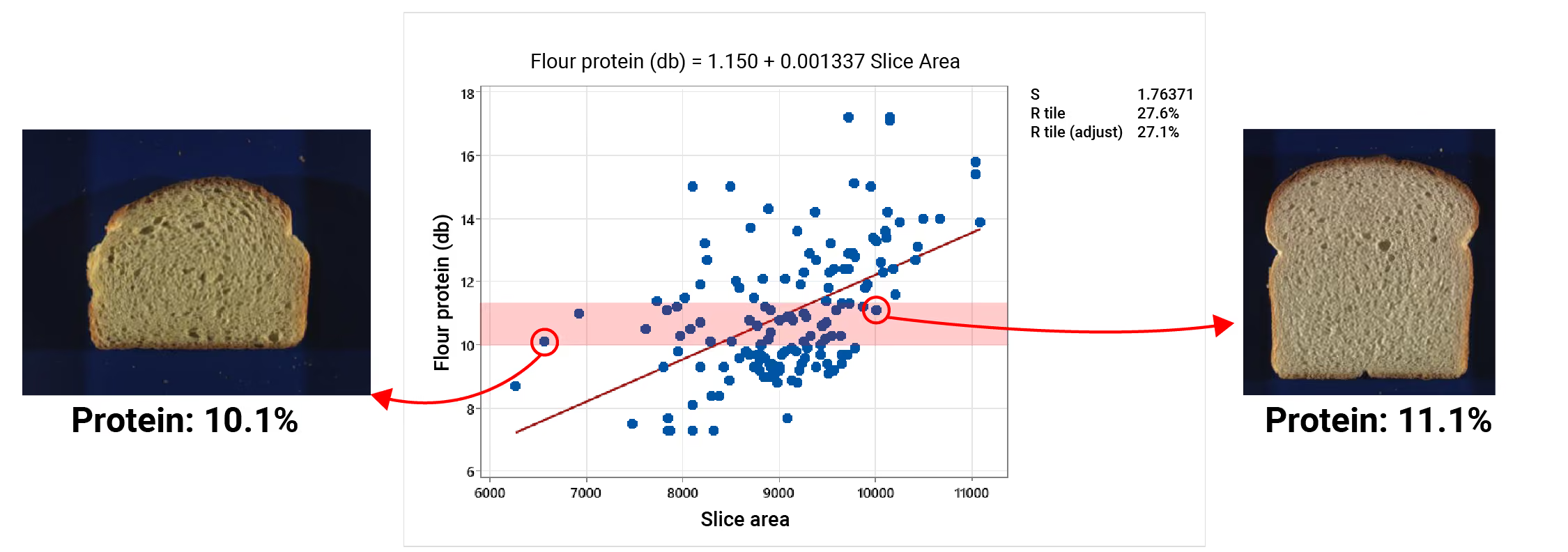
In general, flour protein content has traditionally been a significant factor in a flour COA. Protein is inherently an essential piece to the puzzle, and it is convenient and easy to measure it precisely. As shown in Figure 1, the amount of protein in flour does not always indicate the final product.
Many bakers who have adopted a process-driven approach to flour quality control will agree that protein quality rather than protein quantity is far more critical to the outcome.
The truth is – a fact that has been proven many times over in baking plants worldwide – there is no such thing as ‘good’ or ‘bad’ flour. Instead, some flours are better suited for one baking process or product line than others. Now, in this unique era in baking industry history with fewer traditional master bakers on staff, bakeries can embrace a shift to a ‘process-adapted’ flour quality COA, which put them in the best position to develop the quality standards for their unique operation.
“Now, in this unique era in baking industry history with fewer traditional master bakers on staff, bakeries can shift to a ‘process-adapted’ flour quality COA, which put them in the best position to develop the quality standards for their unique operation.” Arnaud Dubat, Business Development Director, KPM Analytics
Utilizing quality assurance technologies to better understand the process
Flour quality instruments such as the Alveograph test have been around for generations, yet have traditionally been considered miller tools, not baker ones. They all take a sample of flour, run it through a protocol, and generate numbers or values that indicate ‘something’ about the flour’s quality attributes. For today’s average baker, many of whom do not have the formal or technical training of a master baker, these technologies may seem intimidating and impractical to apply in the process.
Many of these technologies are not so technical once the baker realizes they can link the data they generate with a final product. As shown in Figure 2, the ‘Profiler’ feature in the Mixolab Universal Dough Characterizer exports easy-to-follow data curves that provide the ‘fingerprint’ for flour quality best suited to generate the baker’s ideal final product. Then, let’s suppose the miller uses the same testing equipment the baker uses. In that case, the miller can also be more proactive with their flour formulations by matching their analysis curves with the baker’s, using their expertise to make the necessary adjustments for the baker’s needs before the flour leaves the mill.
The value of these quality assurance instruments is not in the individual numbers they generate but the fact that the data can help streamline both the baker’s and miller’s processes. With both parties working together to share their data, they can close the loop on quality control, saving time, costs, and future frustrations.

Bakers can become more influential in the flour specification process
Bakeries produce goods; they know their processes and recipes better than anyone. However, they also directly suffer and pay the ultimate cost when operations do not work as expected. The more the flour is a key element of the baker’s process, themore important it is that they decide what is good for them.
However, the miller’s role is still critical in this new flour quality specification approach. Because millers are already using flour quality control technologies, they can work more closely with the bakers to develop a process-driven COA. This collaborative effort can go a long way in reducing baker complaints and chargebacks – a win-win scenario.
The key to the best-possible product results is in bakers taking more control in developing their flour COAs. By incorporating flour analysis technologies into their process, the next generation of bakers can decide whether the flour they are using is process-adapted or non-process-adapted, thereby making them more confident that they will continually achieve an ideal final product that their customers love.