AI "Eyes" on the Future for Potato Packers & Processors

This article originally appeared in an issue of Potato Gazette. Click here to read the full issue.
Humans have long been fascinated by artificial intelligence (AI) to enhance efficiency and simplify daily life. In recent years, with the rapid development of AI assistant applications like ChatGPT and Google Gemini, the idea of having an AI avatar ready to serve its users is no longer a novel concept, but something that is quickly becoming a necessity today.
From a potato processor’s perspective, the increasing pressure to boost throughput, control labor costs, and meet customer demands for consistent potato quality has compelled many sheds to innovate quickly. The potato industry is hungry for innovation and automation; manual observation and sorting methods of the past cannot meet today’s demands.
As the calendar turns to 2026, many potato sheds have set their sights on the future, wrapped in excitement and skepticism regarding the role of AI in their operations. The good news is that many early-adopter potato processing facilities have laid the roadmap to AI inspection success for others to follow.
How AI Inspection Works in Potato Processing
Legacy vision sorters depend on color to spot defects, but potatoes with their earth tone, dirt covering them, the defects themselves all look nearly identical to these systems. That’s why, despite their benefits, conventional solutions fall short of enabling a lights-off facility. AI-powered vision changes the equation, delivering insight and accuracy that surpasses human capabilities.
Many processors may think an AI inspection system is an all-seeing, all-knowing powerhouse that, once installed on a line, is left up to its own to make critical process decisions without human intervention. For certain AI systems, this could not be further from the truth.
Generally, each AI inspection system consists of high-resolution cameras, sensors, and process monitoring software with machine learning algorithms to evaluate product and foreign materials in real-time. The real difference lies in the creation and training of the AI model.
There are essentially two different types of AI-based vision inspection systems: unsupervised and supervised AI. Unsupervised AI refers to an AI system that is left to its own judgment regarding product defects, anomalies, and foreign materials. Unsupervised systems may be more capable of detecting unforeseen anomalies, which is acceptable for food products where there is little variation (e.g., a cookie/biscuit line where each product is shaped and baked to the same size, color, texture, etc.). However, because potatoes exhibit a wide range of natural variations, defects, and appearances, using an unsupervised AI method can introduce more false positives or negatives.
Supervised AI technologies are carefully trained by human AI experts to guide AI in making correct decisions. In a supervised AI application, the system is shown several thousand images of good products against product defects to develop an AI model. Over time, the AI model is reinforced by experts and learns what is and is not acceptable through continual training from AI experts after the system is deployed in production.
While supervised AI requires substantial upfront effort to train and deploy on a potato line, the natural variability of potatoes—and the potential for costly or harmful foreign materials to enter the process—makes this human “touch” within the AI especially valuable. Embedding human judgment into the training data has enabled successful and compelling applications for users.
How Will Potato Processors Use AI Inspection in 2026 (and Beyond)?
Potato Inspection at Intake
The point at which potatoes arrive from the grower and are loaded into a receiving hopper is a critical and potentially costly part of the potato processing operation. Pre-sorting is where most foreign materials, such as roots, rocks, golf balls, and other field debris, can enter the process, requiring a careful eye to find these difficult-to-spot unwanted items. Each foreign material that makes it into the customer packaging can cost the potato shed tens of thousands of dollars.
Some potato sheds have solved pre-sort potato grading and foreign material detection using a 'smart table' AI system. In these applications, potatoes are placed on a roller table that provides a full view of each potato to the AI-based camera system. In the blink of an eye, faster than a potato falling off the end of the table, the AI system trained models to detect defects and foreign materials.
When well trained, a smart table system calculates the percentage of any defects (overall shape, rot, %green, bruises, rodent/insect damage, broken parts, etc.) and automatically reroutes those defective potatoes into their defined process stream by triggering rejection fingers to remove the potato as it drops through the system. When the system detects foreign materials, a different set of rejection system triggers and moves them into a discard bin.
Smart table systems are designed to handle high product volumes – up to 63,500 kg (140,000 lbs) of potatoes per hour – providing a dependable first check of product before later process phases.

In-Line Potato Sizing and Grading
As most potato shed owners will agree, there is no such thing as a bad or unusable potato. After washing, most potatoes are typically routed into their value streams, where specific customers, such as potato chip manufacturers, process potatoes for ingredients or processed foods, #2s, or fresh-pack potatoes for supermarkets and restaurants.
Traditionally, human sorters observing the line would manually remove potatoes from a conveyor line and direct them into several process streams. With today’s throughput speeds, this sorting method is too subjective and impractical for sorters to manage effectively. In some regions, particularly in the United States, maintaining this labor has been especially challenging in recent years, resulting in numerous quality assurance complaints from customers.
To solve these quality challenges, some potato sheds have installed AI-powered multi-lane potato sorting systems. Much like the smart table systems, as potatoes pass through the sorting lanes, a camera system takes pictures of the traveling potatoes, instantly assessing potato size, shape, and presence of defects. Based on its reading of the potato, the system triggers a rejection finger to drop the potato onto a dedicated value-stream drop lane in the sorting line, or a rejection bin for cull potatoes.

Final Product Sorting & Packing
In fresh pack potato sheds, even after potatoes undergo their preprocessing steps and head to the packing line, there remains a possibility that some defective potatoes will still reach the packing line. Here again, hand sorters are the final line of defense for spotting these under-spec potatoes before they leave for the customer.
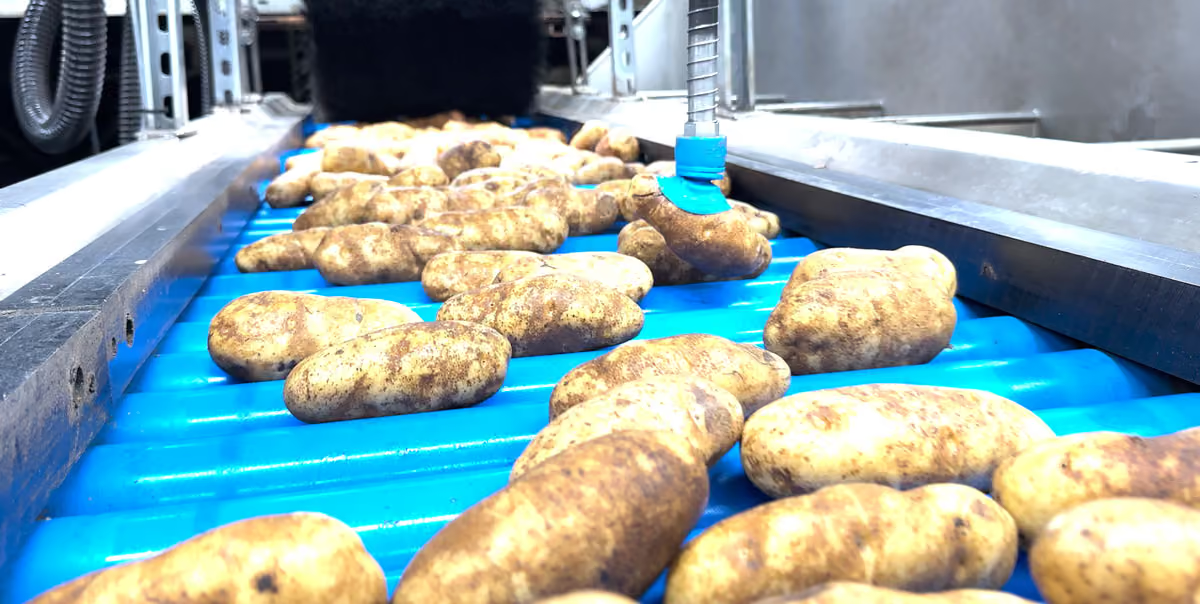
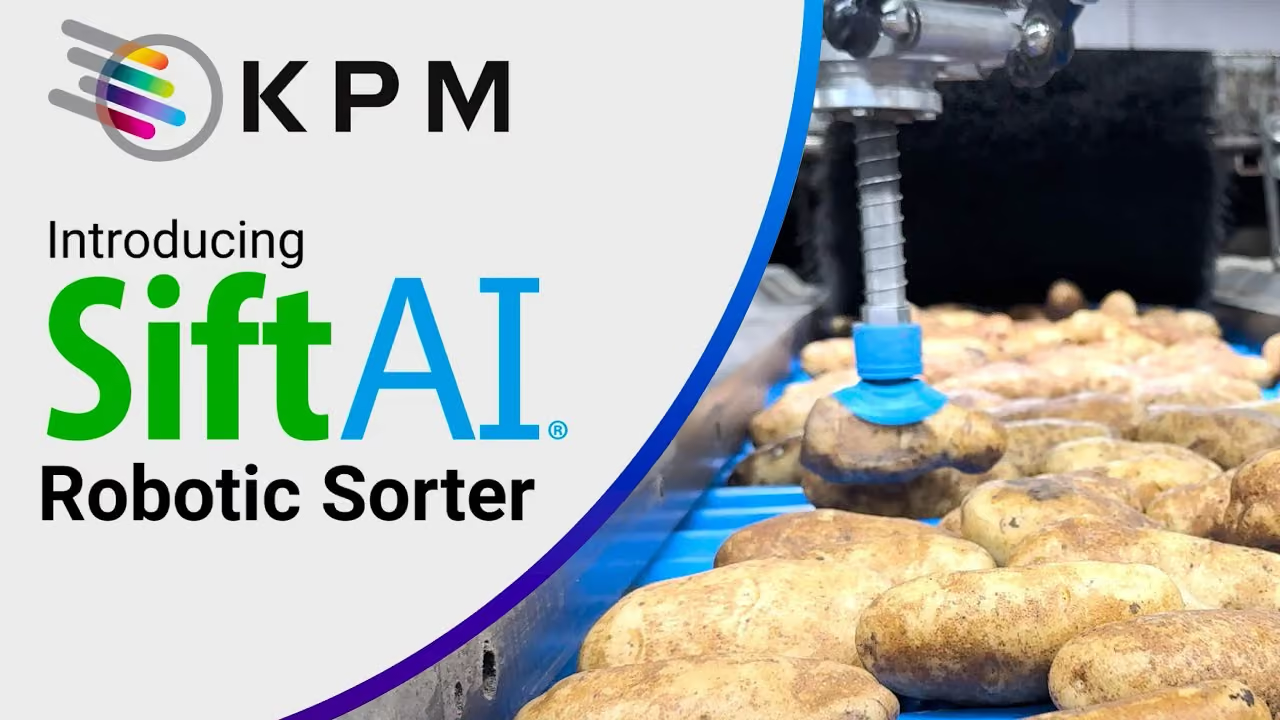
Recently, applications pairing an AI-based inspection system with a Delta robot have emerged as a high-powered, efficient way to check final potatoes for quality specifications before packaging. Like the previously covered applications, cameras linked to an AI system analyze potatoes on a rolling table, applying AI models to validate the potatoes’ visual traits. Based on its findings, AI technology will trigger the robotic sorting arm to pick up and remove the unacceptable products into the correct value streams.
Robotic sorters eliminate subjectivity from the decision-making process, resulting in fewer mistakes, fewer chargebacks, and substantial labor savings. In fact, users who have integrated two robots onto a sorting line have achieved removal rates of between 80 and 100 potatoes per minute – far faster than a team of human sorters can accomplish.

Smarter Processing Lines for Stronger Bottom Lines
AI does not replace the people or processes in a potato shed; it enhances them. Ultimately, the value of AI inspection extends beyond replacing manual tasks or reducing errors – it can quantifiably enhance and scale operations to meet growing demands. By delivering consistent, objective, and fast product inspection, AI applications maintain output quality when labor is limited or turnover is high. Processors can reduce waste, protect downstream equipment, and confidently meet customer specifications without sacrificing line speeds.
Today’s AI inspection systems have progressed beyond the theoretical lab or testing phases – they are designed for real-world production and are ready to serve now and into the future.