Puffing in Baked Products: How Flour Builds the Layers That Define Quality


Why Puffing Matters
Puffing is what separates a great croissant from a flat one. Those distinct layers, the air pockets, the volume: none of it happens by accident. Puffing creates the light, airy texture that consumers expect in laminated pastries, and it signals that the process, the ingredients, and the flour quality are all working together correctly. A flat or dense product immediately reads as lower quality. For flatbreads like pita, puffing serves a different but equally important purpose: it creates the characteristic pocket that defines the product. Whether the goal is flaky layers or an open interior, puffing is a direct expression of how well flour composition supports gas production, retention, and structure during baking.
Transformation of Dough - Explore the Keys to Puffing
In the Back to Flour Series, Transformation of Dough shows how flour composition controls puffing, and how quickly the balance can be lost if any one component is out of range.
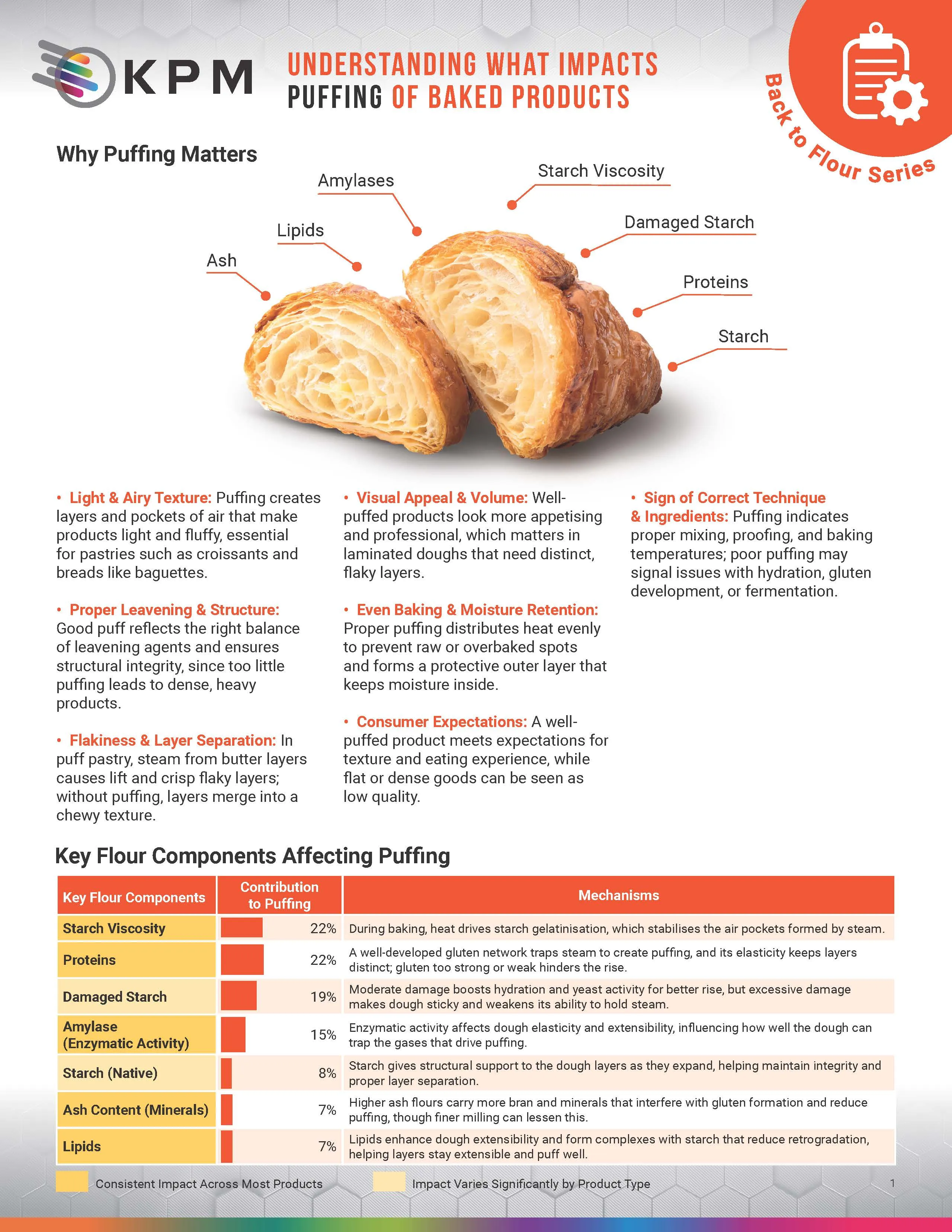
As discussed in the video, puffing is primarily a baking phenomenon. When the product enters the oven, fat melts and layers begin to separate. At this moment, protein becomes less structurally active while starch gelatinization takes over as the dominant mechanism. Proper starch gelatinization stabilizes the air pockets formed by steam and gives the structure that allows layers to hold their shape and volume. A well-developed gluten network is equally important: it traps steam during this phase and keeps layers distinct. Gluten that is too strong or too weak both hinder the rise in different ways.
Damaged starch plays a precise role in hydration. Too little water makes the dough hard and prevents proper layer separation. Too much softens the dough to the point where separation fails and the structure collapses. Moderate damaged starch levels support the right hydration balance, and their coupling with enzymatic activity also drives gas production during proofing. However, excess amylase activity can cause the product to over-develop during proofing and then collapse in the oven, a failure mode the video explicitly identifies.
Lipids enhance dough extensibility and form complexes with starch that help layers stay pliable and puff well. Ash content, when too high, introduces bran and minerals that interfere with gluten formation and reduce puffing capacity.
As the video concludes: if you can measure it, you can improve it. Puffing is controllable, but only with the right understanding of how flour components interact.
For a Quick Overview of Puffing
Alongside the video, we provide a PDF guide summarizing how flour components, starch viscosity, proteins, damaged starch, amylase activity, native starch, ash content, and lipids, influence puffing and how their impact compares across croissants and flat bread.
📄 Download the PDF: Understanding What Impacts Puffing of Baked Products
What’s Next?
Puffing connects directly to other attributes explored in the Back to Flour Series, including flakiness, crumb structure, volume and rise, and fermentation performance.
The Back to Flour Series is constantly growing, with videos, technical PDFs, and resources across At the Table, Transformation of Dough, Secrets of Flour, and more technical insights to come. Explore the categories below and stay tuned as we continue to connect flour functionality with product excellence
Explore the categories below and stay tuned as we continue to connect flour functionality with product excellence.
.avif)