Slicing in Baked Products: How Flour Composition Determines a Clean Cut


Why Slicing Matters
A clean slice is more than an aesthetic detail. It signals product quality, reflects the right crumb structure, and determines how a bread performs in the hands of the consumer and on the production line. A slice that tears, crumbles, or collapses makes a poor sandwich, reduces portion consistency, and signals something wrong with the formulation or process. Slice thickness also matters: the thinner the slice, the faster moisture is lost, and the shorter the effective shelf life. Whether the product is pan bread, a hamburger bun, or a loaf destined for industrial slicing, the ability to cut cleanly depends directly on flour composition
Transformation of Dough - Explore the Keys to Slicing
In the Back to Flour Series, Transformation of Dough shows how crumb structure, built by flour components during baking, determines whether a product slices neatly or falls apart under the blade.
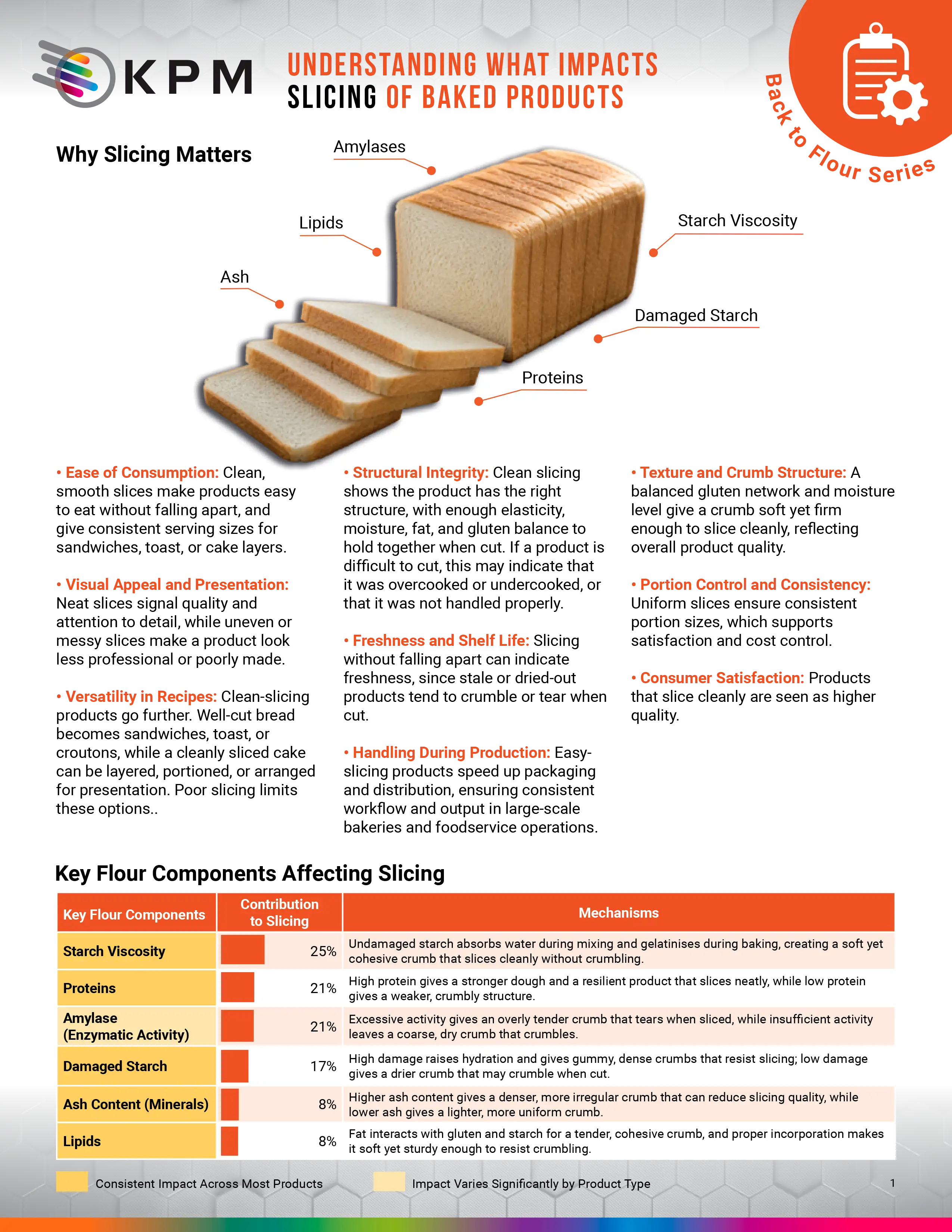
As discussed in the video, the crumb structure is the foundation of good slicing. What happens during baking, specifically starch gelatinization, directly shapes that structure. If gelatinization is excessive and the inside becomes sticky, the slicer pulls at the crumb rather than cutting through it, causing collapse. If the crumb is too dry or understructured, it crumbles. The right level of starch viscosity creates a soft yet cohesive crumb that holds together cleanly when cut.
Protein quality plays an equally important role. A well-developed gluten network maintains the shape and resilience of the crumb during slicing. As the video makes clear, quality matters more than quantity: the right protein quality holds the product together without making it too dense or too fragile. Amylase activity must also be carefully controlled. Excessive enzymatic activity degrades starch, lowers viscosity, and produces excess moisture at the surface, making the crumb stickier and harder to slice. Insufficient activity, on the other hand, leaves a dry, coarse crumb that crumbles when cut.
Damaged starch influences hydration: high levels produce gummy, dense crumbs that resist the blade, while low levels give a drier crumb prone to crumbling. Lipids contribute to a tender, cohesive crumb by interacting with gluten and starch, keeping the structure soft yet sturdy. Ash content, when too high, produces a denser and more irregular crumb that reduces slicing quality.
For a Quick Overview of Slicing
Alongside the video, we provide a PDF guide summarizing how flour components, starch viscosity, proteins, amylase activity, damaged starch, ash content, and lipids, influence slicing quality across pan bread, hamburger buns and more.
📄 Download the PDF: Understanding What Impacts Slicing of Baked Products
What’s Next?
Slicing connects directly to other attributes explored in the Back to Flour Series, including crumb structure, moisture retention, starch gelatinization, and shelf life.
The Back to Flour Series is constantly growing, with videos, technical PDFs, and resources across At the Table, Transformation of Dough, Secrets of Flour, and more technical insights to come. Explore the categories below and stay tuned as we continue to connect flour functionality with product excellence
Explore the categories below and stay tuned as we continue to connect flour functionality with product excellence.